“Giving birth should be your greatest achievement not your greatest fear.”

~Jane Weideman

.

Birth is Sacred. It is powerful, and mysterious, and life changing. After your birth, you and your partner will never be the same. Babies who come into this world without medication or interference are better able to find their way to the breast and to latch on in that first important hour. They are born alert and ready to meet you face to face. Mothers who are educated about birth and trust their bodies and attendants are more likely to have a smooth birth experience, and feel empowered in doing so.
Showing posts with label rvabirthcenters. Show all posts

Monday, May 23, 2016

Orgasm During Childbirth?

It may be a rainy Monday, but we come bearing good news- at least for the lucky 6% of you! Multiple sources have credited this phenomenon of orgasm during childbirth and this doula, Bailey Gaddis has witnessed it herself! Below are tips on how to facilitate such an experience, so read on and may you be blessed!


I'm A Doula, and Let Me Tell You: Orgasms During Childbirth are a Real Thing!
By: Bailey Gaddis

The terms “orgasm” and “childbirth” sound like antonyms to most people. But, women have an orgasm when they conceive a baby (hopefully!), so maybe it’s not outside the realm of reason that they could have an orgasm while birthing the baby.

According to The Independent, a survey by the Positive Birth Movement and Channel Mum has reported that 6 percent of women say they have had an orgasm during childbirth. My initial reaction when I first heard about women who reported orgasms during birth was that they were lying braggarts — mainly because I was jealous I had never experienced this phenomenon.

But since I’ve become a birth doula, my “lying braggart” theory has been crushed; I’ve witnessed many women experience multiple orgasms during birth. I’ve heard them describe these births as “ecstatic overflows,” “spiritual awakenings,” “waves of bliss,” and “the longest, strongest, orgasm ever!”

I wonder if these will be the ladies that end up having six children?

This miracle outcome is not based in fantasy, but in science. Studies have shown that two of the regions in the brain (the anterior cingulate cortex and insula) that are active during orgasm are also active during painful sensations — and childbirth is often labeled the pinnacle of painful experiences.

Beyond similar activities in the brain, orgasm and childbirth both produce strong surges of blood and stimulation of the birth passage, cervix, clitoris, and vagina. And sometimes, they both involve the partner whispering sweet somethings in the mother’s ear — or, teetering on the edge of sleep.

A professor of psychology at Rutgers University, Barry Komisaruk says, “Anatomically, orgasmic birth is no surprise. In fact, the intense stimulation of the vaginal canal in childbirth may work to block pain, whether that stimulation is felt as sexual or not.”

Are you hoping for an orgasm during childbirth? Why not, right? Try out these suggestions to up your chances:


  • Substitute the term “contractions” (it sounds so constrictive!) with the term “surges” — which sends a more fluid and pleasurable message from the mind to the body.
  • Take deep-in-the-belly breaths during each surge, allowing the belly to fully rise. Breathe past the wall of pain, and you might just find a special treat on the other side.
  • Envision a spiral of energy moving from above your head, down through your body, and concentrating its power as it moves out your cervix and washes over your vagina and clitoris. Imagine that energy waking up your body’s endorphins as it moves down, and dispersing them through the pelvic region.
  • Submerge yourself in warm water as much as possible. The relief warm water provides to your hard-working birthing muscles creates space for them to focus on more pleasurable pursuits.
  • When you feel yourself at the tipping point of pain and pleasure, let out long and low groans to allow any painful energy to be released.
  • Have your partner stimulate your nipples during surges. This act pumps up your release of oxytocin, which can strengthen your surges — increasing the potential of a quicker birth, and awakened arousal.
  • Ask your partner (or self!) to stimulate your clitoris. In 1988, Barry Komisaruk and co-researchers published a study in the Journal of Sex Research, which noted that vaginal or clitoral stimulation made women less sensitive to painful stimulation.

I imagine women have been experiencing orgasmic births since the beginning of humankind, but have likely been sticking to the motto “mum’s the word.” Now that sexuality is losing a bit of its taboo status, more women are coming forward about their ecstatic birth experiences.

Hopefully, the sharing of this possibility can spark renewed hope (maybe even excitement!) in women who are terrified of the prospect of birth, and removes the belief that there is shame in a woman feeling bursts of pleasure in an experience where pain is the standard.

Maybe, childbirth can hurt so good.

Tuesday, May 17, 2016

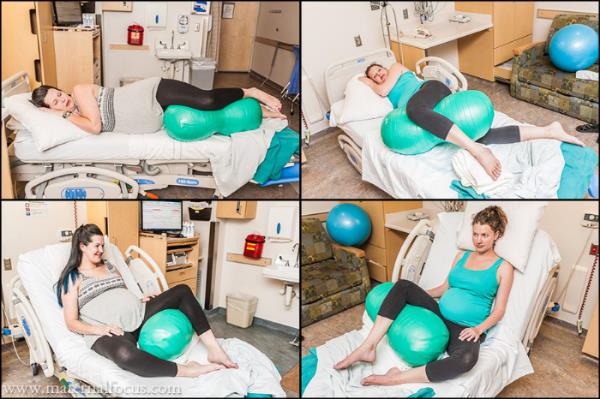
Using a Peanut Ball in Labor

From Director of Birthwell Birthright, Tanya Strusberg, comes an amazing article on the benefits of using a peanut ball versus pillows, blankets or even a traditional swiss ball.  Specializing in Lamaze childbirth education, she is a great resource for natural birth techniques.  We utilize the peanut at Embrace Birth Center and think it's an extremely useful tool for mothers to promote dilation and increase comfort.


What is a peanut ball and why could it be helpful for me in labour?

Most people are familiar with the standard birth ball (sometimes called a fit ball or Swiss ball). They come in a range of sizes to suit women of all heights and are without doubt an essential labour tool to have.

The standard round birth ball has become a common site in a birthing suite, but the peanut ball is a relative newcomer.  In the last few years, the use of a peanut ball for labour has increased, especially for mums who choose an epidural or who need to rest. The peanut ball doesn’t slip, slide or flatten like pillows, keeping a mum’s legs properly supported and the pelvis open. The use of a peanut ball has been seen to help shorten labour. Although there has not been a large study on their effectiveness, many midwives and hospitals are seeing excellent results.

A peanut ball is similar to a birth ball, except that it dips in the middle, giving it its distinctive peanut shape. Peanut balls also come in a variety of sizes, again depending on a woman’s height, but also depending on how she plans to use it. Smaller peanut balls are designed to be used between your legs, whereas larger peanut balls are designed to be sat on, or to lean over.


Peanut Balls are typically used two ways primarily:

1. The labouring mother is in a semi-reclined position, with one leg over the ball, and the other leg to the side of the ball. The doula, midwife, or other support person pushes the ball as close to the mother’s hips as is tolerable for her. Many feel this position promotes dilation and descent with a well-positioned baby.

2. While the mother is in a side-lying or semi-prone position, the peanut ball is used to lift the upper leg and open the pelvic outlet. Many feel this position helps rotate a baby in a less-favorable posterior position to a more favorable position for delivery.


What size peanut ball should I use?

Peanut balls come in a number of sizes:

45cm – Recommended for women who are under 160cms
50cm – Recommended for women who are 160cm – 170cms (most common size)
60cm – Recommended for women who are 174cm or taller or plus size women
70cm – ONLY to sit on and straddle


For the full article along with even more great resources, click here to visit the Birthwell Birthright website.

Monday, May 16, 2016

Grand Opening Success! Take a Peek Inside

We had such a lovely time at our Grand Opening yesterday!  It was a successful event and we were so thrilled to be hosting amazing moms, expecting mothers, their partners, and their children!  It was all around joyful to be sharing something that we have been working so hard towards these past few months and seeing it all come to fruition.  Embrace Birth Center is up and running along with our Wellness Collective!  If you didn't get a chance to visit us yesterday, here's a peek at what's inside!

 Welcome to our Birth Center!  Our very own Kathryn Haines is speaking to expecting parents in the Midwives meeting room!

Here we have everyone gathered in one of our birthing suites, along with our examination room and our sitting area at the front entrance.  The photography you see around the office are all works of local photographers you can work with for your very own pregnancy and infancy portraiture!  The collection shown here is of actual births we've performed in Richmond.

This is one of our amazing birth suites, built with maximum comfort in mind.  A space for your family - a retreat - with extra deep soaking tubs, plush linens, and private bathrooms!

We are very excited about this little tree!  We will be hanging snaps of all the beautiful babies we deliver on its branches!  Blue for water babies, green for earth babies!

Our Wellness collective features Green Baby Planet, who focuses on safe, natural and eco-friendly products for your little ones!  We also offer prenatal yoga classes!  There is still room available in our collective, so if you'd love to contribute to this wonderful community of support, please contact us.


Tuesday, May 3, 2016

Just Some of the Benefits of Water Birth


“Do you perform water births?” is one of the most frequently asked questions we get and what the majority of mothers that come to us are looking for.  We recommend that all our mothers at least consider laboring in water, but are happy to deliver earth babies as well! When you think about the environment your baby has spent the last 9 months in, that warm, amniotic fluid— giving birth in water seems natural.  It makes your baby’s transition from that environment into the loud and bright outside environment that much easier.  The decreased sensation of gravity also makes positioning for the mother less strenuous in water and promotes.  Some of the well-known benefits of water birth include:

— Decreasing pain 
— Decreasing length of labor
— Conservation of energy
— Reduces perineal trauma
— Relaxes and soothes mother to get in tune with her natural rhythm


Our new Birth Center will be opening this Tuesday, May 10th, with our Grand Opening Event and Open House on Sunday, May 15th!  It will feature 2 beautiful water birth suites that meet all of the American Association of Birth Center guidelines, extra deep soaking tubs, private bathrooms, showers and queen-size beds.  All of the comforts of home.